
By examining the question of finitude in Kafka's texts, Dominik Zechner's study addresses a largely unspoken central theme of his literature. Finitude is not understood here as just one topic among others, but as the inherent problem of Kafka's writing, insofar as it concerns the production and functioning of meaning and its legibility. For as much as Kafka's texts revolve around the inescapability, enigmatic nature, and indeed the finitude of existence, their language resists a definitive reading—it always requires further interpretation and, precisely where death and closure should be the subject, constantly opens up new possibilities for interpretation and ways of continuing the narrative.
In 15 successive sections, the Germanist and philosopher Zechner explores how Kafka's language occupies a liminal space between "death and the precarious curve before it," constantly creating new threshold spaces and intermediate zones. For the reading of the texts, this means that the alternatives they explore structurally resist a decision in favor of a single pole, and it is precisely therein that their often-acknowledged depth is to be found. Zechner illustrates this through meticulous readings (such as "The Judgment," "The Trial," "The Castle," and others), demonstrating how reductive and misleading simplistic interpretations must remain—often leading to the revision of prominent readings.
Zechner playfully succeeds not only in demonstrating the workings of Kafka's texts, but also in illuminating the philosophical problems they address. With a delight in language and wit, this essay becomes a surprisingly lighthearted exploration of the relationship between language and finitude, death and meaning: "In linguistic terms, death is always already a representation of itself—and therefore not death at all, but rather the survival of its representation."
Faculty Bookshelf
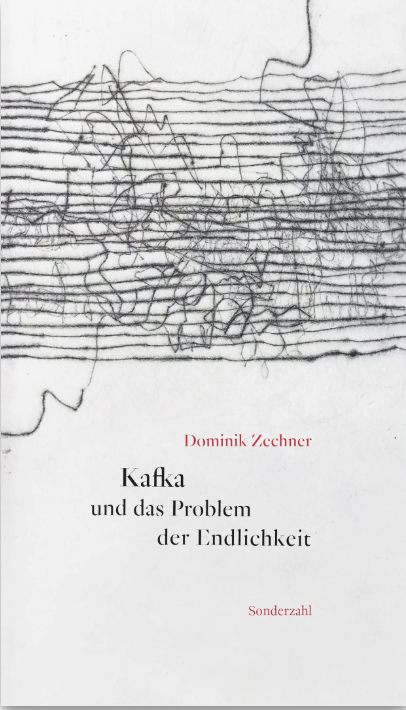
- Publisher / Date: Sonderzahl Verlag / June 2024