
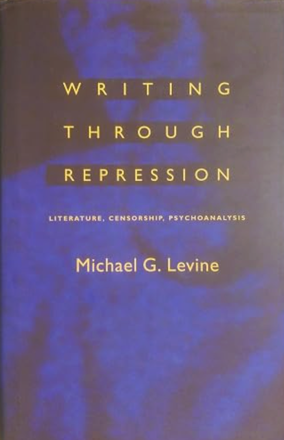
In this highly original study Michael Levine asks the provocative question “What does it mean to treat a dream as a censored text?” The author traces Freud”s borrowing of the concept of dream censorship from the realm of politics and examines with considerable subtlety the consequences of this appropriation. He explores the way this genealogy shapes Freud”s thinking about unconscious modes of articulation and representation, asking how, in turn, a close reading of Freud might bear on such issues as the problem of self-censorship. The book argues that just as unconscious thinking in general allows mutually exclusive wishes and identifications to exist simultaneously without canceling each other out, so too must “frontier” concepts like censorship and repression be understood as “disjunctive conjunctions,” which join and separate forces in a highly compromised manner. While a language of frontiers, borders, and border guards may initially help one to situate these liminal instances in a psychical topography, Writing Through Repression demonstrates how Freud”s understanding of the conflicts inhabiting and informing them leads to a “different, more dynamic sense of psychical space.” (In developing this dynamic model of reading, Levine astutely enlists Shoshana Felman”s “displacements” and Samuel Weber”s “disruptive distortions” as clues to how the figurative language of psychoanalysis can provide an indirect, “necessarily distorted access to processes not otherwise available to analytic scrutiny.”)
Levine is equally concerned with the temporal problems posed by a Freudian notion of articulation. He argues that just as censorship is impossible to locate spatially as a particular frontier, temporally it will only have taken place as pre- and/or post-censorship. Thus the dreamwork and the dream censorship never simply meet or confront each other as two opposing forces because the two are much more intimately connected than it at first appears. Because the site of their interaction is difficult to locate as such, Freud is forced to describe such conflicts by tracing movements of displacement and distortion (Entstellung). In addition to studying the split temporality of censorship, the book examines temporal structures in Freud”s writings on repression, trauma, transference, and primary narcissism. These analyses [End Page 1055] are supplemented by extremely interesting discussions of Heine (to whom Freud owed his dominant metaphor) on self-censorship, Benjamin on the notion of shock defense, and Kafka”s singular reframing of Ovid”s metamorphic narrative.
In addition to these temporal and spatial aspects of articulation, Levine also addresses articulation in its more conventional sense of enunciation. He argues that Freud”s language stages a series of missed or indirect encounters with an object of study that cannot be approached more directly. In other words, Freud”s language not only has difficulty describing particularly elusive and resistant objects but also actively constructs these objects. Therefore, to study unconscious processes it is necessary to follow the modifications, slippages, and performative dimension of Freud”s own language: his texts not only describe unconscious modes of articulation; they also and above all stage them.
Levine then argues that this three-fold sense of articulation can best be studied by treating Freud”s writings as “intertextual hinges.” Certain tensions can best be brought out by reading his work in conjunction with literary and critical texts whose own conflictual dynamics are in turn exposed in these encounters with Freud. The book is thus a comparative study in a new key. The articulation of its successive concerns can be briefly summarized: (a) the first section deals with Freud, Heine, and the relationship of dream and self-censorship; (b) the second traces the connection between censorship and repression; (c) the third reads Freud”s Beyond the Pleasure Principle as refracted through Walter Benjamin”s essay “On Some Motifs in Baudelaire,” turning then to Benjamin”s notion of shock defense (approached through a reading of “A Note on a Mystic Writing Pad” and the idea of “two-handed Writing”); and (d) the book concludes with chapters dealing with Totem and Taboo and the essay “On Narcissism,” and a brilliant reading of these texts in conjunction with Ovid”s Metamorphoses and Kafka”s “The Metamorphosis.”
Writing Through Repression is shrewd and detailed in its close readings of Freud”s figurative language and that of the conjoined, “hinged” authors. But it is also courageous in recognizing what resists any frontal attack by the reader”s critical intelligence. Following the détournements in Freud”s thought (and that of his most provocative interpreters), Levine accepts, and invites us to accept, the risks of the “unpredictable, singular, and transformative encounter with that which remains opaque and unassimilable in any text.”